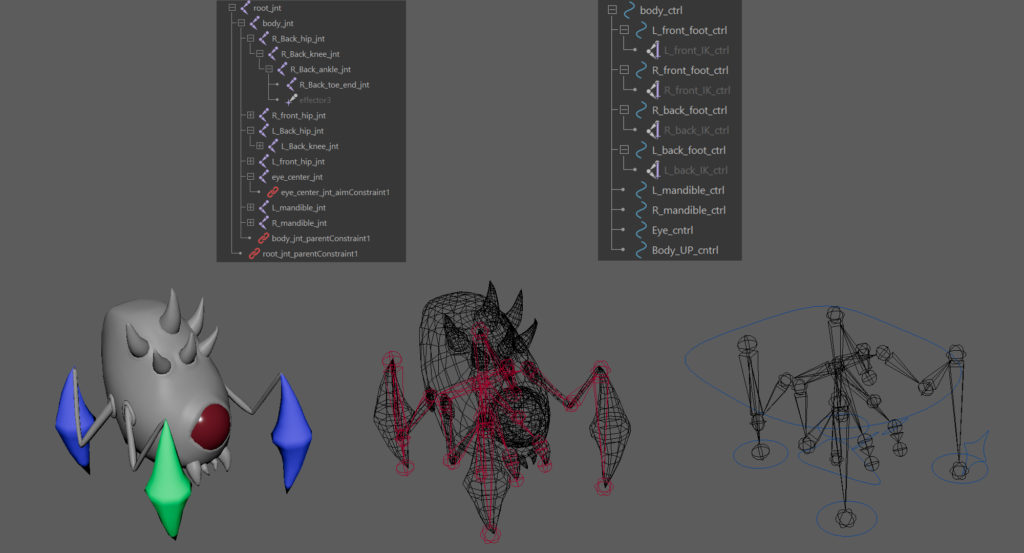
I recently had the chance to work on a really fun creature: a fictional 4-legged spider. The base mesh was provided by our talented 3D modeler, and after making a few minor adjustments, I dove straight into the rigging phase.
My goal was to build a robust rig with custom controllers that could smoothly handle the required animation states like Idle, Run, and Attack. Since a 4-legged spider doesn’t actually exist in nature, I studied the movement of a praying mantis and adapted its walk cycle to fit our creature. To keep my sanity while animating all those joints, I color-coded the legs in Maya. This simple trick made tracking their individual movement trajectories so much easier. Once the animations were polished, I ensured a perfectly clean FBX export over to Unity.
The ECS Challenge This is where things got technical. Our game uses a very strict custom Entity Component System (ECS) framework (Rukhanka). When I brought the spider into the engine, it was completely frozen. Our programmer actually struggled to solve this rendering issue, so I decided to take the lead and debug the pipeline myself.
First, I configured the rig as Generic rather than Humanoid since it lacks a standard head, set up the root node, and built the Prefab hierarchy exactly as the ECS expected. I then dug deep into the live runtime data using the Entity Inspector. I could see the SkinMatrix buffers updating perfectly. The math was working, but the mesh was still static.
I quickly realized the culprit. Standard URP shaders simply cannot read ECS deformation matrices. To fix this, I imported a custom Shader Graph, wired the ECS deformation blocks directly into the Vertex outputs, and adjusted the instance parameters. The moment I swapped the material, the spider instantly came to life. Bridging the gap between the Maya animation and the engine’s codebase, and helping the programming team overcome a tough roadblock, was incredibly rewarding.
The Knight: Dynamic Combat and Cape Rigging
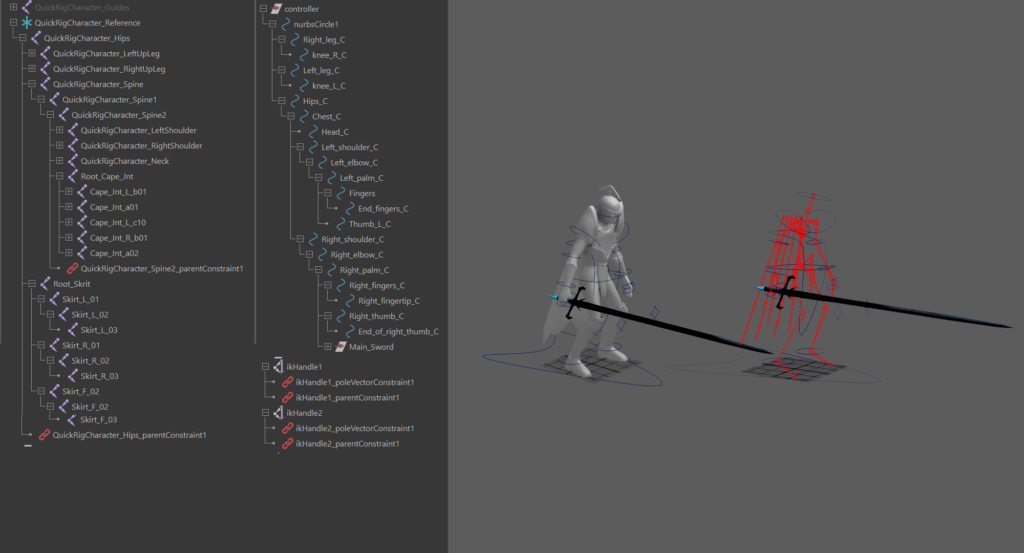
ext up was the Knight character. I received the base model but immediately noticed the cape lacked the necessary topology to flow naturally. I went in and added extra geometry to the cloak so it could flutter beautifully in the wind. From there, I built a complete custom rig and controllers from scratch. The animation phase was especially fun. I crafted a core moveset including an Idle, Run, Jump, and a fluid 3-stage Combo Attack. The combo was particularly interesting to set up because the animation transitions needed to feel snappy and highly responsive, completely depending on how fast the player mashes the attack button. To give the character a truly epic feel, the cape needed special attention. I created a custom joint chain specifically for the cloak to ensure it moves organically. Once inside Unity, I integrated the Magica Cloth 2 plugin to drive those joints and implement stylized dynamic cloth physics. This setup made the cape flutter and react perfectly to the wind and the character’s heavy run cycles, which really tied the whole dark fantasy vibe together.
The Armless Barbarian: From Scratch Modeling to Dynamic Rigging
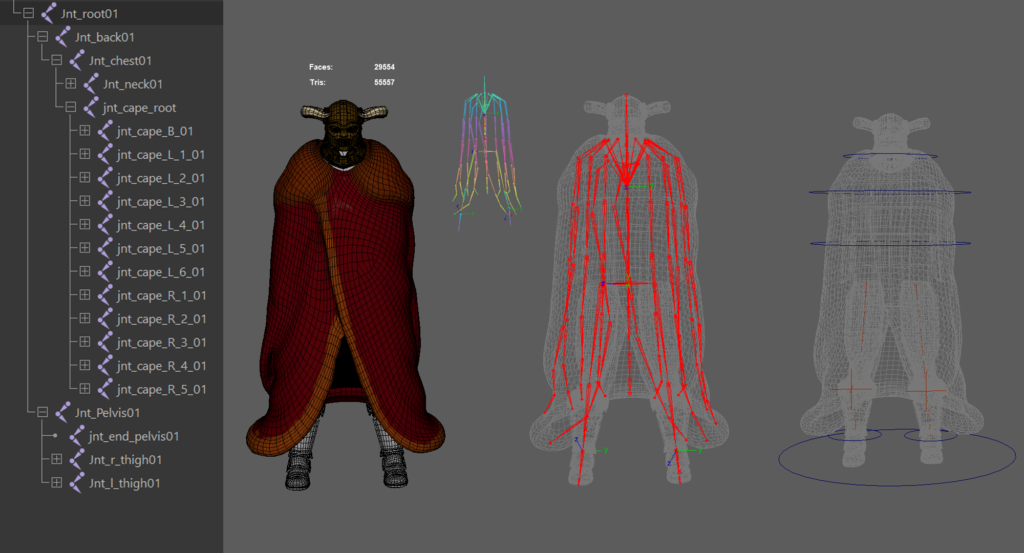
The Armless Barbarian: From Scratch Modeling to Dynamic Rigging I took this character from the very first concept all the way to completion, modeling the Barbarian entirely from scratch. The design is completely armless, which presented a really unique and fun challenge. How do you animate a heavy, intimidating brawler who doesn’t use his hands? Since his attacks are generated in the space around him without him physically striking, the rig and animations had to convey pure power entirely through his core, hips, and legs. I built a custom skeleton and control setup focused on transferring weight and energy during his attack states. Even without throwing a punch, his body mechanics had to make him feel incredibly dangerous. To emphasize his silhouette, he wears a heavy cloak that wraps around his body. I created a dedicated rig specifically for this garment so it dynamically flows, unwraps, and twists around him as he moves. The motion of the cape essentially compensates for the lack of arms, giving his character design a lot of fluid motion and a dominating presence during gameplay
The Ten-Tails (Juubi): Taming a Rigging Nightmare
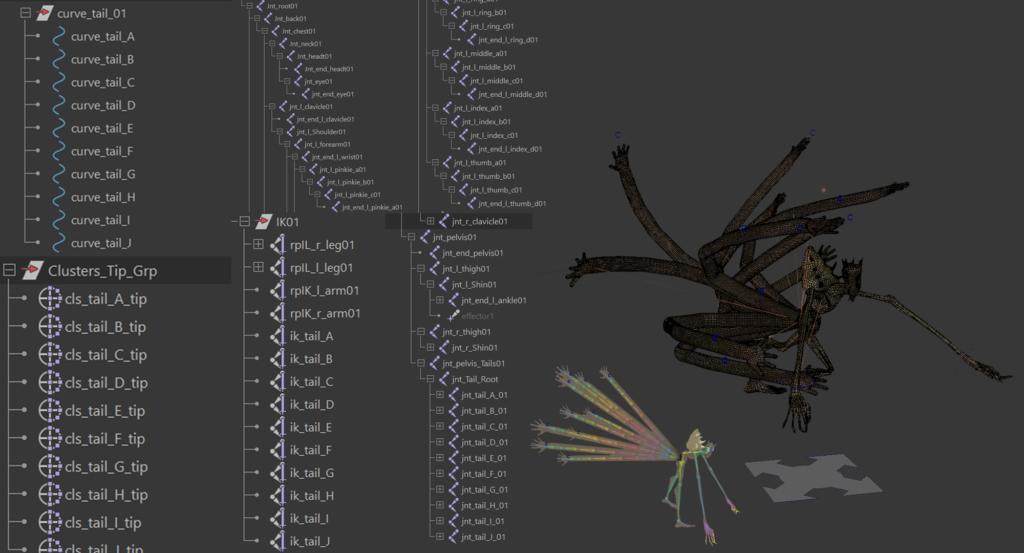
For this project, I took on the massive Ten-Tails creature from Naruto. Rigging a grotesque giant with lanky limbs, fully articulated hands, and exactly ten massive tails is a technical puzzle I couldn’t wait to solve. The main body and limbs required a solid foundation. I set up Rotate Plane IKs (rpIK) for the arms and legs to give them that heavy, planted feel, and made sure to rig every single finger joint since its hands are such a creepy, expressive part of the design. But the real challenge was obviously the ten tails. Animating ten huge appendages joint-by-joint using Forward Kinematics would be a nightmare for any animator. To solve this, I built a dedicated IK Spline system for the entire tail section. I generated individual curves for each of the ten tails (curve_tail_A through J) and attached Clusters to their tips. This setup allows the animator to drive the entire length of a tail smoothly just by grabbing a tip cluster, creating fluid, whip-like motions with minimal effort. Keeping the outliner this organized was crucial to making such a complex creature actually fun to animate.